Longstanding Conflict between Mormons and Gentiles
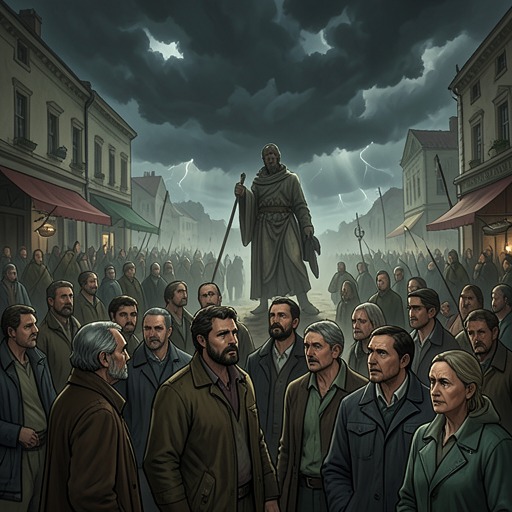
Under the Banner of HeavenThe conflict between Mormons and Gentiles was not a single dispute but a recurring struggle over who could claim a place, govern a community, and define the law. Mormon leaders and followers understood themselves as God’s chosen people, while non-Mormon neighbors and federal officials often viewed their separatism and concentrated authority as threats. Persecution deepened Mormon solidarity and distrust; that history, in turn, could be invoked to defend resistance to outside authority and to intensify hostility toward outsiders.
Zion, Belonging, and Exclusion
The conflict took shape as Mormon settlement expanded into places where established residents did not share the newcomers’ religious commitments or political aims. In Jackson County, Missouri, many Mormon immigrants came from the Northeast and favored abolition, while many local residents had Southern roots and owned enslaved people. Yet the book identifies more than this sectional divide: residents were also alienated by Mormon clannishness and the conviction that the Saints, as God’s chosen people, had a divine right to claim the area as Zion.
The Saints’ actions made that claim visible in everyday economic and political life. They used church funds to buy substantial tracts of land, traded preferentially with one another, and voted as a bloc in accordance with Joseph Smith’s directives. As their numbers increased, local residents feared that Mormons would come to dominate county politics. Mormon doctrine sharpened the division: the world was framed as two opposing churches, and people who rejected the Saints’ religious claims could be treated as having chosen wickedness rather than as neighbors with legitimate differences.
In 1831, a revelation described Missouri as both the Saints’ inheritance and the land of their enemies. Such language made the conflict more than a contest over land or elections: it cast settlement as a sacred entitlement and opposition as evidence of hostility to God’s plan. Local meetings and anti-Mormon resolutions failed to halt the influx, and residents of Independence eventually took matters into their own hands. The pattern of religiously grounded claims meeting local resistance would recur in later settlements.
Nauvoo and Rival Legal Orders
After leaving Missouri, the Saints built a new center at Nauvoo, Illinois. The town grew rapidly, reaching more than fifteen thousand residents within five years, and its unusual charter, passed by the Illinois General Assembly in December 1840, granted it a degree of autonomy rare in the United States. Nauvoo thus became more than a refuge: it was a theocratic principality with Joseph Smith at its head, and a place where church authority and civil government were closely joined.
Joseph Smith’s political power had both civic and military dimensions. He was formally styled King, Priest, and Ruler over Israel on Earth, commanded the well-armed Nauvoo Legion, and sought authorization from Congress for a force of one hundred thousand men. Congress declined that request, but in January 1844 he announced his candidacy for president. For supporters, these claims could appear consistent with the authority of the one true church; to outsiders, they raised questions about the reach of a religious leader and the independence of an armed, self-governing city.
The clash between church and state was also expressed as a conflict between legal systems. Later in Utah, Brigham Young maintained that God’s law took precedence over human law. Because Utah remained a territory, federal courts were supposed to hold legal power, but the Mormon-dominated territorial legislature expanded local probate courts, which Young controlled. Mormon bishops commonly served as probate judges, and church members formed almost all the juries. The arrangement allowed church authority to shape local legal outcomes and challenged the federal government’s claim to jurisdiction.
That claim was not only a matter of institutional design. In the contemporary dispute over polygamy, a Colorado City police chief defended the privacy of religious households, while the book notes that polygamy was illegal throughout the United States and Canada and police officers were sworn to uphold the law. The competing assertions—religious liberty and household autonomy on one side, public law and police duty on the other—showed how the older struggle over jurisdiction could continue inside a community as well as between a religious group and outsiders.
Persecution Remembered, Conflict Renewed
The murder of Joseph Smith and the continuing danger to the Saints in Hancock County intensified the cycle of violence. In the summer of 1845, anti-Mormon vigilantes led by Levi Williams burned Mormon homes and farms; by September 15, forty-four residences had been destroyed. On September 16, Porter Rockwell killed Frank Worrell, an officer who had been responsible for guarding the jail on the night Joseph Smith was murdered. Days later, Mormons killed a young Gentile man they suspected of burning homes. These acts deepened hostility rather than resolving it.
By this point, armed parties on both sides were moving through the county, burning and plundering homes. More than two hundred houses were destroyed. Fearing that Hancock County was on the brink of civil war, Governor Thomas Ford sent four hundred troops to Nauvoo and a committee of prominent negotiators. Brigham Young offered a cease-fire in exchange for the Saints’ departure not only from Illinois but from the United States. The Gentiles accepted the proposal on October 1, 1845, giving the Mormons time to prepare for evacuation.
The conflict drove the search for a new homeland, but relocation did not end it. On February 4, 1846, the first emigrants crossed the Mississippi River from Nauvoo into Iowa. At Sugar Creek, the Saints openly shared the doctrine of plural marriage with ordinary members of the group, while leaders continued to deny the practice to the outside world. The Saints’ new home, first beyond the national border, was soon incorporated into the United States after the war with Mexico. Utah’s annexation and the subsequent creation of Utah Territory again placed Mormon aspirations for self-government under federal authority.
Federal Power and the Utah War
In Utah, the dispute acquired the form of a confrontation between territorial leaders and Washington. Federal officials complained that Brigham Young had made the territory a theocratic dictatorship. Many encountered relentless harassment; most eventually left, and some feared that Porter Rockwell might kill them. Young, meanwhile, resisted federal oversight and declared that the Saints would make Utah a sovereign state or an independent nation. In March 1857, the Utah Territorial Legislature announced that the Saints would disregard federal statutes they judged unjust and expel federal officers who failed to meet the church’s moral standards.
President James Buchanan responded in May 1857 by sending officials to reassert federal rule, including a new territorial governor, and ordering twenty-five hundred soldiers to escort them to Salt Lake City and subdue the Saints if necessary. The Utah War ended through negotiation before the two sides exchanged fire. Its scale nevertheless reflected how a contest over religious practice and local autonomy had become a test of federal power. The Saints’ experience of earlier expulsions, and the fear that the government intended to destroy them, gave the confrontation an emotional force beyond the immediate question of who would govern the territory.
As the troops approached, church leaders repeatedly recalled the deaths and expulsions in Missouri and Illinois, including Joseph Smith’s murder. Rumors circulated that the army had orders to hang Young and exterminate the Mormons. Across Utah Territory, public speeches revived the Saints’ history of mobbings, burnings, and expulsion from Nauvoo, reinforcing the resolve never to be driven out again. Militias drilled in towns throughout the territory, and Mormon bishops were told not to sell supplies to Gentile wagon trains. Young also asked whether the Saints would burn their own towns and crops if the army entered Deseret; the reported answer was unanimous agreement.
The passage of persecution memory into preparation for conflict is central to this account. Remembering past violence helped bind the Saints together, but it also turned new threats into repetitions of earlier wrongs and cast outsiders as a collective enemy. The book links this atmosphere to the hostility that greeted the Fancher party, an Arkansas emigrant train that crossed the Wasatch Range into the Great Salt Lake Valley on August 3, 1857, shortly before continuing toward California.
Later Echoes and the Cost of the Boundary
The same boundary between a religious community and outside authority appears in later disputes over marriage and state intervention. When Ruth Stubbs left Colorado City with her children in 2002 and publicly described her marriage as abusive, her case placed a polygamous police officer’s household within the reach of state law and brought the police chief’s religious defense of privacy into direct tension with his official duty. The episode illustrates how the conflict could persist not only as a confrontation between governments but through decisions about who was protected, believed, and permitted to leave.
The case of Ruby Jessop exposes a related failure of intervention. At fourteen, she was forced into marriage with an older relative in a ceremony presided over by Warren Jeffs. After trying to flee, she was allegedly taken from her brother’s home in May 2001 and brought to her stepfather, Fred Jessop. Her sister Flora reported the disappearance to the county sheriff, but a deputy who visited Colorado City accepted church leaders’ statement that Ruby was on vacation and left. A month later, the Utah Department of Child and Family Services arranged for Ruby to meet with a social worker in St. George. Interviewed in the presence of a man identified as one of her alleged abductors, Ruby said she was fine and was returned to members of the faith.
Ruby later gave birth at sixteen, and no one outside Colorado City had heard from her since the summer of 2001. Her sister continued trying to secure help, but the state’s response contrasted sharply with its later rescue of Elizabeth Smart and prosecution of her abductors. The contrast makes the limits of formal authority plain: the state could claim jurisdiction, yet whether that authority protected an individual depended on whether officials pursued the case and credited the available evidence.
The conflict’s recurring structure is therefore both political and intimate. Claims of religious belonging and divine law could oppose the jurisdiction of neighbors, courts, and federal officials; resistance from those authorities could then be understood through a remembered history of persecution. That history helps explain the persistence of the confrontation without making its harms inevitable or excusing them. Across Missouri, Nauvoo, Utah, and Colorado City, the unresolved question remained how a religious community’s demand for autonomy could coexist with the law and the rights of people living within its boundaries.